

The Cherry Orchard | Harold Pinter Theatre

Anton Chekhov’s final play, The Cherry Orchard, has been adapted and restaged many times in its more than 120-year history. Now, Sonia Friedman Productions presents a new adaptation by Conor McPherson which proves the play’s timeless resonance with audiences,
Kristin Scott Thomas takes the starring role of Ranevskaya, and star she certainly does, embodying the central character’s almost childlike desire to hide in the past and ignore the problems of the present which threaten to overwhelm her and her family. She is a magnetic presence on stage, and it is easy to see why the other characters are unable to resist being pulled into her orbit.
Opposite her, Stephen Mangan plays Lopakhin, or ‘Yermi’ (the Russian literary habit of saddling every character with a multitude of nicknames means that a guide is necessary for the uninitiated), the son of a serf who has reversed his fortunes and is now financially superior to the aristocratic family at the heart of the piece. Mangan leans into the often farcical elements of the play as he attempts to pull Ranevskaya into the future and battles his own feelings for her.
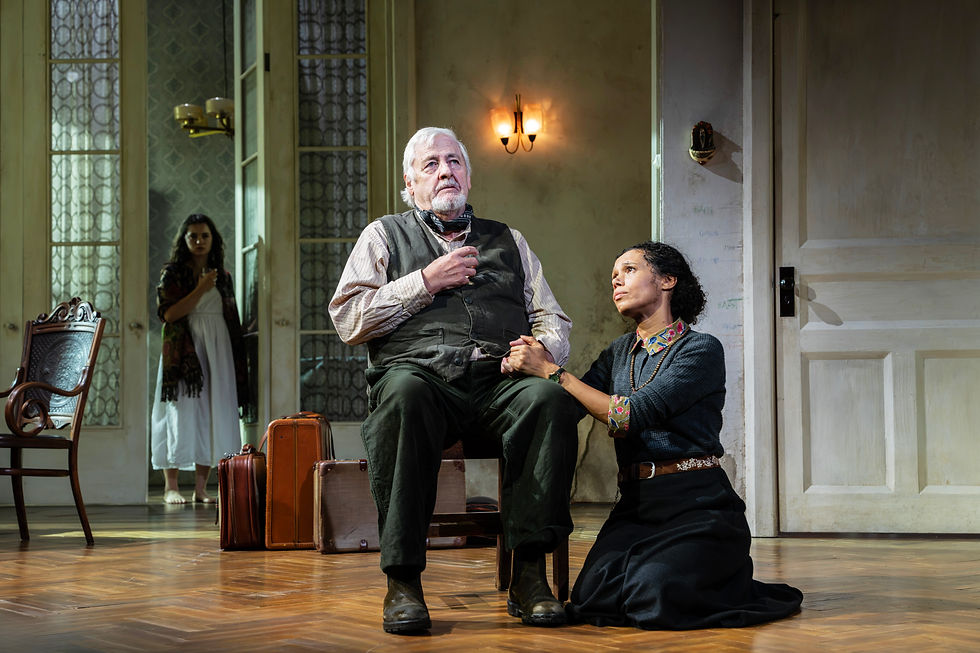
A whole host of supporting characters also fill the stage, each with their own backstories and subplots. Most compelling among these are Vinette Robinson as Ranevskaya’s adopted daughter Varya, who has struggled to keep the house afloat while her mother has been away, and elderly valet Firs (Karl Johnson), a bewildered figure who has clung onto his position and the old way of life just as firmly as Ranevskaya.
The eponymous cherry orchard is never actually seen, with the action taking place in a decaying room in Ranevskaya’s house which overlooks it. Set designer Chloe Lamford has created an atmospheric set, encapsulating both the house’s former grandeur and its decline, with little touches such as height lines crayoned onto the wall nodding to the ways in which the family history is intertwined with the house, a central theme of the piece.
Lighting from Bruno Poet creates the illusion of daylight streaming through great windows to the side of the stage, and effectively marks the passage of time through the piece, while Tom Gibbons’s sound design allows flashes of the outside world to penetrate the interior.
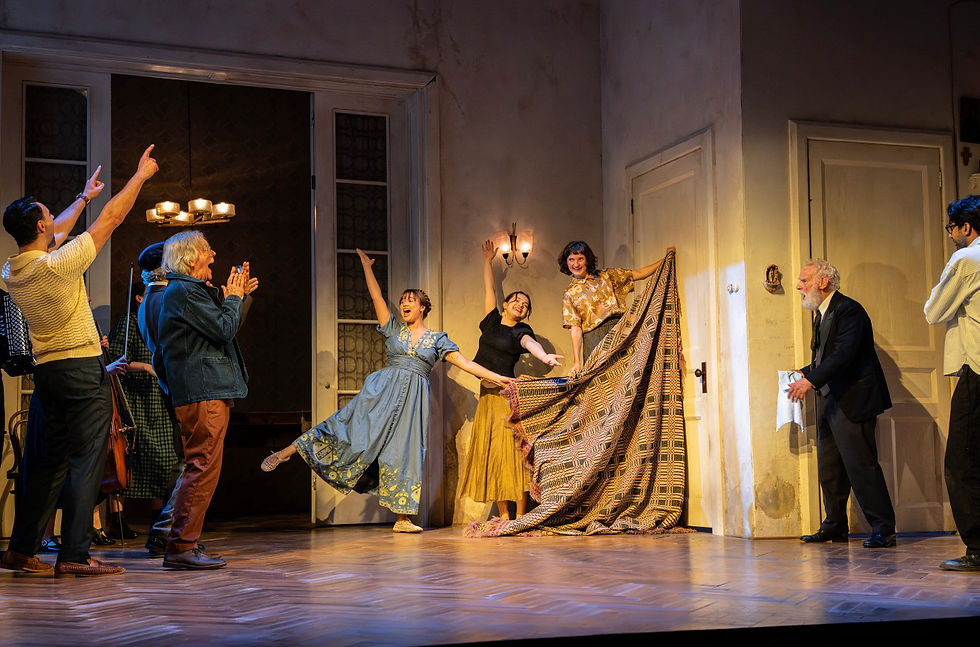
The broader setting is somewhat ambiguous, with references to the historic and cultural setting of Chekhov’s original maintained (this play was originally written in 1903, with the Russian Revolution looming, though the writer never lived to see it), while the language of Conor McPherson’s adaptation and elements of Susie Juhlin-Wallen’s costuming tend more towards the modern, hinting at the timelessness of the piece’s themes.
In an interview published in the play’s programme, director Ian Rickson, speaks of the duality of the piece, a subject for debate since its conception. Chekhov himself saw the play as a comedy, while original director Konstantin Stanislavski framed it as a tragedy at its opening in Moscow in 1904. This current production leans more heavily on the comedic elements, sometimes to the point of farce, though it is often the moments of pathos that resonate most strongly and more could be made of this.
A compelling production, and worth the watch for Kristin Scott Thomas’s performance alone, this new adaptation proves the enduring relevance of The Cherry Orchard.
The Cherry Orchard runs at the Harold Pinter Theatre until 9th January. For more information and tickets, follow the link here.
★★★★☆ (4*)
Gifted tickets in return for an honest review | Photography by Johan Persson



Comments