

Blood Brothers | Storyhouse Chester

Some stories entertain; others break your heart. Willy Russell’s Blood Brothers does both, with a devastating force that remains undiminished.
Arriving at Chester’s Storyhouse as part of its Autumn 2026 UK tour, Bill Kenwright’s acclaimed production reminds us why this extraordinary musical has endured for decades. Funny, poignant, musically rich and ultimately shattering, it is a theatrical experience that takes its audience through an astonishing range of emotions before delivering a finale that feels as devastating as ever.
At its heart is the story of Mickey and Eddie, twin brothers separated at birth and raised in strikingly different circumstances. One grows up amid the financial hardship of Liverpool’s working-class streets; the other enjoys the comfort and privilege of a wealthier upbringing. When their paths cross as children, an unlikely friendship blossoms, sealed by a promise to become blood brothers. Yet beneath their childhood games and innocent declarations lies the ominous knowledge that their story is heading towards tragedy.
Russell’s genius lies in the apparent simplicity of this premise. What unfolds is not merely a family tragedy, but a compelling exploration of social inequality, inherited disadvantage, superstition and the uneasy relationship between fate and free will. The question of whether our lives are shaped by nature or nurture becomes increasingly uncomfortable as the twins grow older and the consequences of their very different beginnings become impossible to ignore.
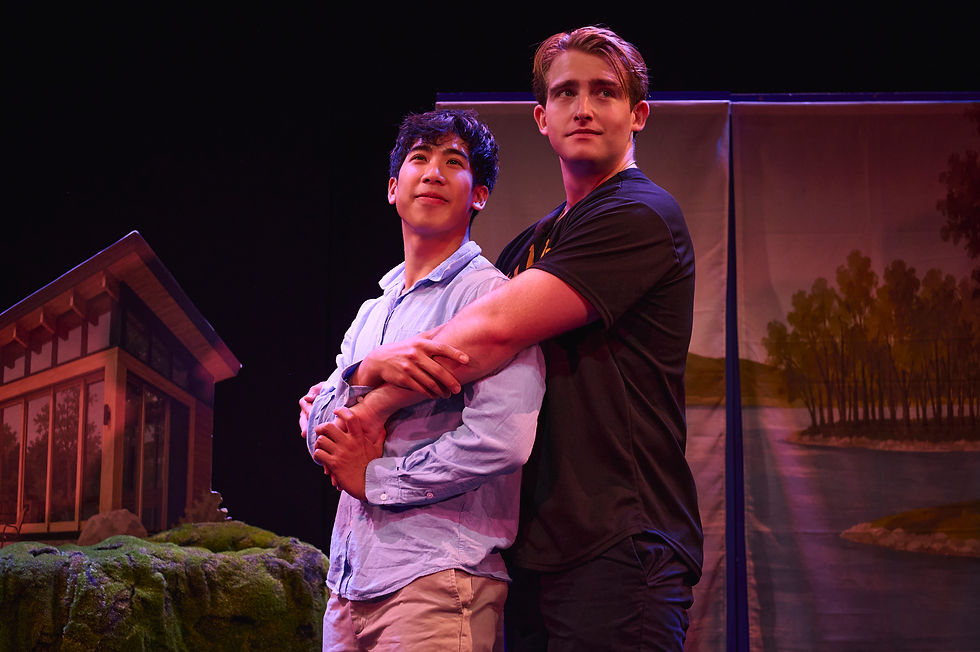
The cast is led by Sean Jones as Mickey and Joe Sleight as Eddie, whose performances capture the infectious exuberance of childhood before tracing the increasingly painful divergence of the brothers’ lives. Their early scenes brim with mischief, energy and the uncomplicated joy of friendship. The boys’ playful squabbles and imaginative games generate some of the evening’s biggest laughs, making their bond feel entirely authentic. Jones has played the role of Mickey for over 25 years, but each performance seems to be just as energetic as the last. This role clearly a very special place in his heart!
Believing in the bond of the brothers is essential. We must first believe in their friendship, and in the possibility of a shared future, before we can fully appreciate the tragedy of its unravelling. As adulthood brings disappointment, frustration and the growing weight of circumstance, the contrast between their lives becomes painfully apparent.

Vivienne Carlyle is impressive as Mrs Johnstone, the twins’ mother, delivering a performance rich in warmth, vulnerability and emotional authenticity. Her beautiful vocals bring an additional depth to the character, conveying the hopes of a woman who wants nothing more than a better life for her children, yet finds herself trapped by circumstances largely beyond her control. There is a heartbreaking humanity to her portrayal: she is neither saint nor villain, but a mother making impossible decisions in an unforgiving world.
Kristofer Harding’s narrator is another outstanding feature of the production. Commanding, unsettling and quietly menacing - he is far more than a storyteller. He becomes the embodiment of fate itself, hovering at the edges of the action and reminding us that the characters are moving towards an ending they cannot see, but which the audience increasingly fears. His interventions lend the production a chilling undercurrent, turning even the happiest moments into something faintly ominous.
Tricia Adele Turner as Mrs Lyons and Beth Danher as Linda add further dimension to the story, helping to illuminate the different pressures, loyalties and vulnerabilities that shape the twins’ lives. The supporting performances bring vitality to the world around them, ensuring that the story feels rooted in a recognisable community rather than existing solely as a tragic fable.
The score is integral to the production’s emotional power. Russell’s songs are not simply interruptions to the action; they deepen our understanding of the characters, expose their anxieties and carry the narrative towards its inevitable conclusion.
The familiarity of numbers such as Marilyn Monroe and Bright New Day offers moments of exuberance and hope, while Shoes Upon the Table reinforces the superstition that hangs over the story like a gathering storm. The cast’s beautiful vocals are a particular strength, allowing the music to move effortlessly between playful nostalgia and profound sadness.
Yet it is the emotional architecture of the score that impresses most. The lighter numbers draw us into the rhythms of everyday life, while the recurring musical motifs subtly reinforce the sense that the characters are caught in a pattern from which escape may be impossible.

And then comes Tell Me It’s Not True. Even though I know the musical intimately, I am never entirely prepared for the emotional devastation of its conclusion. The title itself becomes an anguished plea for a different ending, a desperate wish that what has unfolded might somehow be undone. It is a moment in which the music, the performances and the accumulated weight of the narrative converge with extraordinary force.
One of the production’s greatest achievements is its balance of humour and heartbreak. The childlike characters are wonderfully entertaining, their exuberance and cheekiness providing some genuinely joyful moments. Their games, rivalries and innocent understanding of the world are immediately recognisable, inviting the audience to reminisce about childhood and the friendships that once seemed capable of lasting forever.
These scenes are more than comic relief. They establish what is at stake. The audience sees two boys who, despite their differences, are remarkably alike in their hopes, fears and desire to belong. Their friendship initially seems to transcend the social divisions surrounding them, making the gradual intrusion of those divisions all the more painful. The laughter never feels misplaced; instead, it makes the darker passages hit harder. We move from amusement to apprehension, from tenderness to frustration, and ultimately to a grief that feels almost unbearable. Few musicals manage this emotional balancing act with such assurance.
The production’s storytelling remains refreshingly direct, allowing the performances and the writing to take precedence. There is no need for spectacle to disguise the power of the material. The tragedy emerges from ordinary lives, everyday choices and the accumulated effects of inequality. That simplicity is precisely what makes it so affecting.
Perhaps one of the most rewarding aspects of the opening night performance at Storyhouse, was witnessing the reactions of the young people in the audience. For many, this was their first experience of live theatre, and their engagement was a joy to behold. The laughter at the childish antics, their investment in the characters and their responses to the unfolding tragedy offered a reminder of what theatre can achieve. It brings people together in a shared emotional experience, allowing audiences of different ages and backgrounds to discover a story collectively.
Watching those young audience members respond so wholeheartedly, it was difficult not to feel that the evening had accomplished something beyond entertainment. If Blood Brothers was their introduction to musical theatre, there will surely be many future theatre fans among them.

There is something particularly fitting about this response to a musical so concerned with childhood, opportunity and the lives we might lead. A story written decades ago continues to speak to new generations, proving that its themes have lost none of their relevance.
There is a particular challenge in reviewing a production as familiar and enduring as Blood Brothers. Its ending is hardly a secret, and its most celebrated songs are woven into the collective memory of musical theatre audiences. Yet familiarity does not diminish its impact. If anything, knowing what lies ahead makes the journey more painful, as every moment of happiness is shadowed by the tragedy to come.
Willy Russell’s writing continues to expose uncomfortable truths about class, privilege and the extent to which individual lives are shaped by forces beyond personal control. The musical does not offer easy answers, nor does it allow its audience the comfort of believing that everything could have been different through a single better choice. Instead, it leaves us reflecting on the complex relationship between circumstance, responsibility and fate.
At Storyhouse, this powerful material is brought to life by a cast whose performances and vocals do justice to the emotional demands of the piece. The result is an evening that is as entertaining as it is thought-provoking, as full of infectious laughter as it is of profound sadness. By the final moments, the audience is left with the familiar question of the Johnstone twins’ fate, and with the lingering ache of a tragedy that feels horribly avoidable and yet inexorable. Blood Brothers remains a remarkable achievement: a musical that entertains without trivialising, moves without sentimentality and challenges without losing its humanity.
As powerful as ever, this is a production that reminds us why theatre matters. It makes us laugh, breaks our hearts and sends us out into the night carrying its story with us. And for the young people discovering the magic of live performance at Storyhouse, it may well be the beginning of a lifelong love affair with theatre
Blood Brothers plays at the Storyhouse Chester until Saturday 17th October - tickets and more information can be found here.
★★★★★ (5*)
Gifted tickets in return for an honest review | Photography by Jack Merriman


Comments