

Debate: Baldwin Vs Buckley | Wilton's Music Hall

Debate: Baldwin Vs Buckley is a stage adaption of the historic 1965 debate between African American Author and Activist James Baldwin and American Conservative Author William Buckley. The motion was The American Dream is at the Expense of the American Negro. This historical debate has long been considered one of the most intellectual, influential and important debates, with life-altering results.
Christopher McElroen heads this production as both the adapter and director, a journey that started in 2020 in the aftermath of the BLM movement in America and has gone on to tour successfully since. McElroen has stripped the production to its most simplest, and yet, most striking form. The debate.
The debate occurred on February 18th 1965 at the Cambridge Union Society. Given the importance of the debate and the political unrest of the time in America, the debate was streamed live on the BBC and later rebroadcast in America. Notably, The Votes Righting Act was passed only months following this debate.

The choice to stage this production at Wilton's Music Hall only adds to the historical richness of the piece. Wilton's Music Hall is the world's oldest Grand Music Hall and really helps nurture the sense of greatness that is achieved through the piece. The words, spoken with conviction, passion and emotion, are enhanced by the venue choice, creating a fitting atmosphere. The audience, looking up at the performers, become the audience members sat in the debate. Although rare, there were even moments when audience members, swept up in the moment and encouraged by the performers, made audible reactions to dialogue or even attempted to convey their own support or disagreement. The weight of the words that are already heavy, felt even more prominent within those four walls. With only four chairs for the four debaters and the occasional use of a projection onto the old walls, the words really do become all that matters in this production.
The show wastes no time at all with setting up a larger context of the political landscape of America at the time and instead uses archival footage from the actual debate for the debate's president to introduce the four speakers before allowing the performers to launch into the debate. Baldwin and Buckley are joined by two Cambridge undergraduate students, David Heycock and Jeremy Burford.
McElroen's adaptation has the four performers bring the four debaters alive, repeating and reliving their words with nothing extra added or edited, causing the play to become a re-enactment more than anything else. This, of course, is a welcome choice in context to the play, and is worryingly still relevant today.
As one would expect from such an esteemed debate, the dialogue is intellectual with statistics, examples and history laced through to provide solid speeches. For many, a political debate may not be the first option to spend an evening in a theatre, but the theatricality of the actual debate, along with stellar performances, proves otherwise with a powerful and moving play that becomes gripping. However, this review is not about the actual debate; but McElroen's production. There truthfully is little to discuss beyond the four performers, and the clever choice to have these performers wear the exact same clothes as their real-life counterparts on screen.
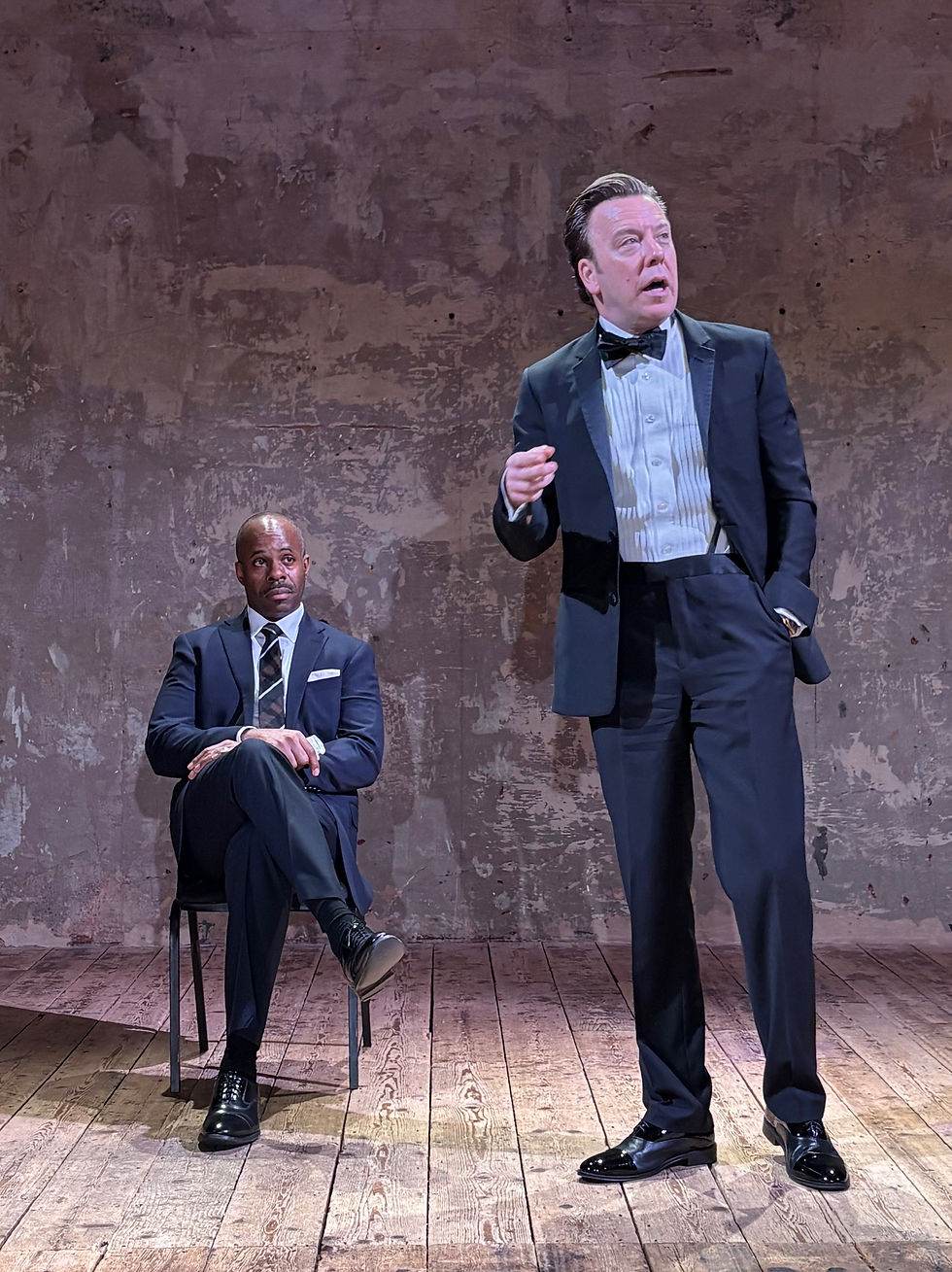
Undergraduate student David Heycock (Christopher Wareham) is the first to address the audience in favour of the motion. Wareham makes a firm first impression with an unwavering confidence in his performance and speech. With nearly ten minutes of time under the spotlight, Wareham maintains the discipline of the debate along with an earnest belief in his words that renders him an impressive talent. Likewise, opposing student Jeremy Buford (Tom Kiteley) nails the determination of a young student who is out to prove his worth. Speaking for the opposition in an already biased audience is never easy, but Kiteley weaves in an effortless charm and warmth into his speech (whilst never wavering from the formality of that the speech demands). Kiteley's naturally more sunny personality comes through in his eyes as he recites many a statistic, a quality that no doubt any orator would want.
Wareham and Kiteley both do an excellent job, but the audience are geared up for Baldwin and Buckley, and soon enough the most crucial part of the debate begins.
Arnell Powell rises up to the challenge of James Baldwin with a quiet confidence that instantly wins the room. As the only black actor, and fighting a cause that is just as frighteningly real outside the theatre as it was inside the wall, Powell becomes THE voice. Powell's performance is magnificent, powering through the hefty dialogue with authenticity and hitting the bullseye with every point. Powell leans into the performance entirely, with the weight of the world on his shoulders, the lived experiences and worn out strength silently providing a visual stimulation. Powell's performance is magnetic, with audiences unable to look away which is impressive for a nearly twenty minute long monologue. As impressive as this was in of itself, it was his moments of emotional outbursts and immediate restraint to remain composed whilst sharing decades of indignation.
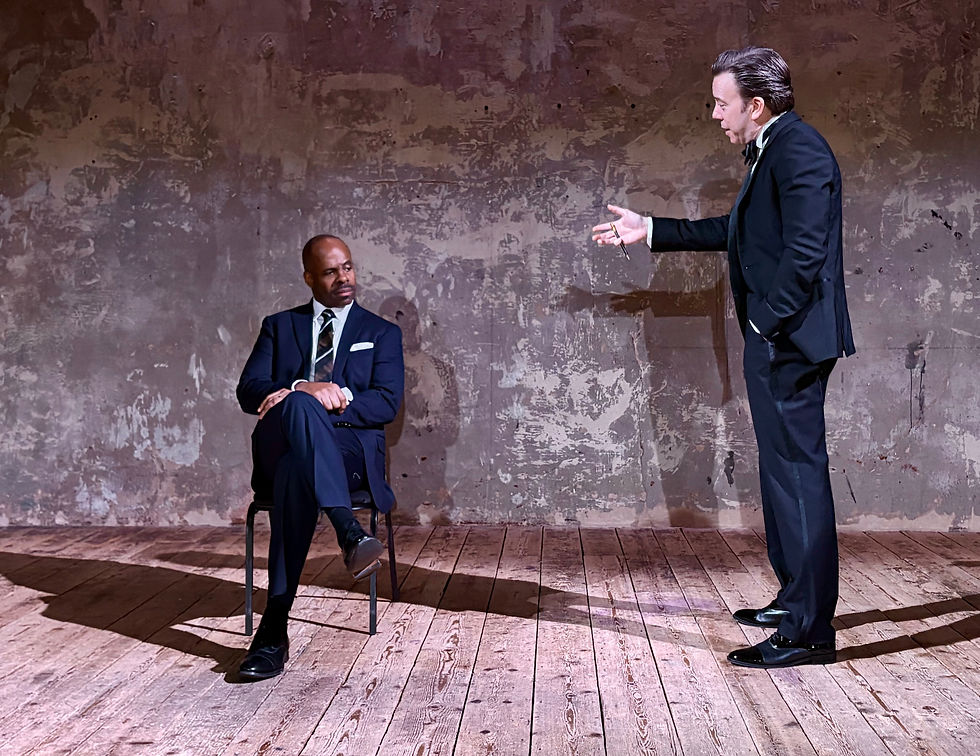
Eric T Miller returns to the production as William Buckley (having previously been a part of the 2023 tour) and delivers an impressive performance. Miller, or perhaps Buckley (audiences were not shown the body language or debating style of the real life counterparts), leans into the humane experience and accountability of the average American Negro. All whilst quietly twisting away from the debate to share his spotlight with Baldwin, creating both a understanding and yet uncomfortable environment. The audience are naturally poised to dislike or atleast need convincing by Buckley, and Miller proves he is more than capable. Miller's slightly more informal tone and welcoming persona, along with his acceptance of audience disapproval places him as a likeable character even if his words are not necessarily so. Miller's loud and confident portrayal accurately captures the spirit of the debate with another impressive performance.
The play ends with the debate's president revealing the ruling (544-164 in Baldwin's favour) shown by projection and ends abruptly. McElroen has ensured that there is no fluff to the piece and that it is cutting and memorable. The play takes on a voice of its own, serving not only as a re-enactment of the original debate, but a reminder, and even warning, about WHY it occurred in the first place.
Debate: Baldwin Vs Buckley is currently playing at Wilton's Music Hall 7th February - you can find tickets and more information here.
★★★★☆ (4*)
Gifted tickets in return for an honest review | Photography by the american vicarious


Comments