

The Ophiolite | Theatro Technis

The Ophiolite, which is written by Philip de Voni and directed by Kerry Kyriacos Michael, is a family drama that explores themes of family, duty, freedom, love and tradition. The play often presents two sides of a coin, with the contrast of two cultures within one family, creating a domestic battle that becomes littered with loss throughout.
Following the death of Takis, a Cypriot who had moved to England and started his own family there, the two sides of his family come together for the first time in years to contest his burial arrangements. His British wife Jennifer (Ruth Lass) had buried him in a local graveyard, having promised him that they'd rest together forever. His Cypriot sister Aristeia (Lucy Christofi) is insistent that his body must be brought back to the family cemetery so he can rejoin his family. The two women are as adamant as the other, with fiery determination that they knew him best. The play's first act sees each woman justifying their side with strong arguments to their respective daughter/niece.
Xenia (Chrisanthi Livadiotis), despite having grown up in Cyprus, is able to understand both perspectives, having studied in London for a few years. She becomes the voice of reason, attempting to play mediator between the two women. Likewise, Penelope (Han-Rose Adonis) is more receptive, understanding and respectful of the Cyprus culture; sharing her father's love for his country. She often encourages her distraught mother to reconsider her firm stance, and help bring the family together.

These four differing perspectives build up tensions throughout the play, and explodes when they're all in the same room to sign legal documents pertaining to inheritance, will and most importantly, the possibility of retrieving Takis body from England back to Cyprus.
Voni's play until this point is a formidable piece of theatre, with every dialogue calculated, deliberately evoking emotional reminders in both characters, and with a mature perspective of two varying cultures. The stagnant and yet sharp bitterness that Aristeia still carries for the British festers into a blistering grudge against Jennifer. Fuelled by a sense of tradition, duty bound and led by love, Aristeia's deception creates a heightened sense of tension. This is undercut and nearly countered by Jennifer's utter bafflement towards the cultural stakes and responsibilities, choosing instead to propel her relationship with her husband in her own right. These two women, are in turn, are brought under further inspection by the next generation, with Xenia and Penelope both trying to bridge the growing gap with love and respect.
However the play outstayed its welcome by the second act, with a significant time jump into the future, following this crucial scene of confrontation and feeling as though it were a new play entirely. With a new dynamic, new characters and new problems, none of which link back to the first act for a long time, the shift is significant and loses the momentum. Emotional outbursts, especially from Penelope, drag the second act out, along with a clever metaphor (that explains the play's title) that is unfortunately repeated too many times to continue having an impact. The play, originally dramatic, becomes melodramatic and leaves audiences muddled for the most part, although it redeems itself in part with a few clever parallels.

This, however, is not to say that the cast weren't all very talented, bringing an authenticity to their performance. Sam Cox is charming and whimsical as the ever optimistic Dominic, Fanos Xenofós is wonderfully slick and sly as Kypros Petrides, and Bea Svistunenko is authoritative and steadfast as Natalya.
Christofi's performance sizzles with a multitude of swirling emotions, impressively convincing of her warmth towards Xenia and her frosty exterior towards Jennifer. Her sentimentality lingers throughout the play, reminding the audience of her heavy grief and devotion to her family and country. Lass delivers a strong performance as Jennifer, expertly allowing audiences to glimpse at her many layers. The complexity of her relationship and understanding of her husband, along with a touch of superiority, makes her a fascinating character to watch unfold.
Chrisanthi Livadiotis is earnest as Xenia and her kindness radiates off of the stage. Livadiotis' portrayal helps drive the play's more subtle themes, as she's torn between two worlds with two perspectives which creates a gentler parallel to the larger conflict, all whilst delivering a heartfelt performance. Han-Rose Adonis shines as Penelope with an emotional and vulnerable performance. Adonis really carries her heart on her sleeve and audiences are swept up in her grief and her own journey as she begins to understand the whole truth.
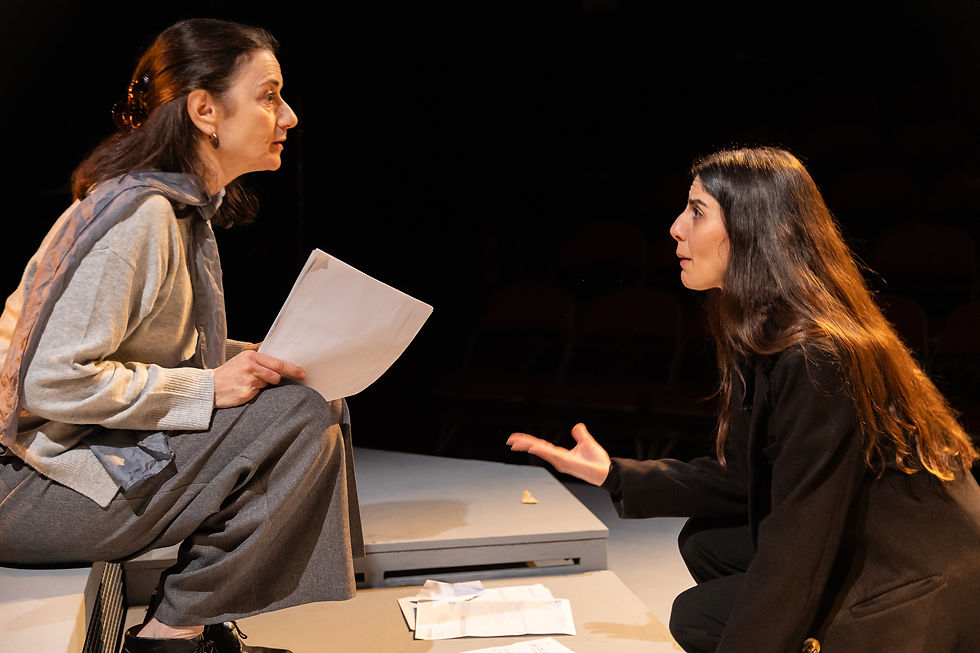
Kyriacos Michael's direction allows for the dialogue to guide the story, with primary focus on placing the actors at opposite ends of the stage and using the stage heights to cleverly hint at who literally has the upper hand. Kyriacos Michael does hone in on the melodrama of the play at times, with exaggerated moments, but these are quite rare and therefore striking.
Cory Shipp's set presents itself as an interesting puzzle at first. The show is presented in the traverse arrangement, but the set is formed of raised white platforms of ascending heights. The Cypriot and British households are staged at either extreme and differentiated through the use of props. This difference is further exaggerated by the warm yellow and cold blue lights (Georgijs Gaisins). The set does allow for good visibility for the most part, yet alienates the audience from the scenes as it is often the performer's profiles that are clearest. The use of stage height is used well to show the downfall of certain characters in key moments.
José Guillermo Puello's sound design washes over the intimate theatre well, providing an important, yet quiet score in the background that elevates the scenes. Gaisins' video design is used extensively, through the use of subtitles for the live translation of the Greek dialogues. Xenia and Aristeia converse almost entirely in Greek, so these subtitles are invaluable to the play, projected clearly onto a lighting box that hangs above the stage. Whilst the subtitles themselves were visible, they did lag at moments, causing a lot of dialogue to be lost in translation, or atleast disrupted the constant flow of the audience's understanding.

The Ophiolite is an interesting play that addresses a theme that is endlessly fascinating and really digs into all possible outcomes and the ripple effect it has on generations of family. Although the second act can feel a little unsteady at moments, on the whole The Ophiolite is still a clever and modernised Greek Tragedy that deals with often undiscussed issues and is worth a watch.
The Ophiolite is currently playing at Theatro Technis until 22nd February 2026 - tickets and more information can be found here.
★★★☆☆ (3*)
Gifted tickets in return for an honest review | Photography by Andreas Lambis


Comments