

Affluenza | Riverside Studios

Affluenza, which is written by Andy Sandberg, kicks off the 'Mainstage Season 26/27', a series of new American writing all directed by Sandberg. Unfortunately, it isn't quite the triumphant start one would hope, instead becoming a play that leaves one with more questions than answers... most of which have to do with the play itself.
Dylan (Noah Schnapp) is a 16-year-old who finds himself potentially charged with manslaughter after he drives a car whilst, resulting in an accident that leaves two dead and several seriously harmed. However, his overly defensive mother, who claims he is just as much a victim (Juliet Cowan) and his ruthlessly offensive father, who blames the system instead (Donald Sage Mackay), are quick to hire a top shot criminal lawyer, Brad (Rupert Young). The first act examines the morality of his mistakes, with Brad, despite initial reservations, taking on the case and using the term 'Affluenza' (Dylan was so blinded by the privilege bestowed upon him by his parents that he could not be held responsible), after a conversation with his wife (Wallis Currie-Wood). Several of the grieving families agree to settle the case, winning millions in the process. However, one father, whose daughter is paralysed in the hospital, vows to get justice, propelling his case to a civil trial and media attention, despite his own attorney's (Janette Manrara) objections.

The show may have a promising premise, yet nothing comes from it due to a frustrating script that avoids taking any accountability and instead tries to turn it into an absurd comedy. Although, whether that is intentional or not is unknown. The show opens mid conversation between the three adults as they continually discuss the events and after effects this car collision has caused, with Brad often pointing out that Dylan had broken several laws and had, unintentionally, killed people. The conversation is an interesting one, drenched in the privilege of the rich, including spending over twelve thousand dollars on a private jet to bring Brad to them. Whilst the conversation can feel repetitive at times, it's fascinating nonetheless at how neither parent are connected to the reality of the situation, made worse by Dylan's appearance to grab yet another beer from the fridge and disappear to play more video games (notably auto theft, where he steals cars and kills people).
Whilst Brad emerges as the only character worth caring about, this quickly sinks as he admits the money is more important and shows his own scaly side throwing Dylan's parents under the metaphorical bus and getting Dylan off with only community service. Audience's must infer this however, for no part of the trial is actually seen on stage but rather is revealed in an angry outburst by one of the victim's fathers. The side plot of bringing Dylan to justice, set up to become an important part of the show, sadly suffers, leading to yet another side topic about race and privilege. Whilst fascinating as a topic, it pulls focus too much here and ends up being an unimpactful moment that feels forced. An unmentioned time jump and the use of several names of unseen or unexplained characters, leaves both this angry father and another mourning mother as baffling characters. It's a pitiful loss for the potential importance of this play that even the most sympathetic of characters are nothing but annoying and confusing inserts. Act one closes with perhaps the show's greatest moment, an impressive use of sound and light to recreate the car crash and leaving Dylan stood alone on stage in a guilty spotlight.

One can only hope that the show would redeem itself in the second act, by picking up at any of the loose ends and interesting subplots, but one would be disappointed. The play instead does a further time jump of 25-30 years (again not mentioned) where a grown up Dylan (now played by Rupert Young) has a reality TV show with his girlfriend Crystal (Wallis Currie-Wood). With never a moment of privacy, the lines blur as the camera crew with Debbie (Manrara) as an assistant with little to do, Liz (Cowan) as an unforgiving director and Ron (Mackay) as a stoner cameraman. The play now explores how fake reality TV is with multiple takes and direction, creating a truly insufferable new set of characters. It feels as though it were a completely different show, with only Dylan's name and house connecting the two acts. Dylan's 17 year old son Todd (Schnapp) is an angry teenager who rejects having his personal life on display and just wants to connect with his dad, pulling yet another focus to the consequences of celebrity status. Without giving away spoilers, the show has a particularly confusing ending that tries to evoke a sense of meaning but really falls flat and is shrouded in more mystery.
Sandberg may have had some interesting ideas that could have become an important and poignant play, especially in the face of the recent news headlines with the Cornell Case in America and white male rich privilege. Though this play is loosely based on a real life event from 2013, it fails to achieve anything but a baffling two hours spent. Had the play opted for either the first or second act and fleshed it out more as a 90 minute piece, it perhaps would have made more of an impact. Not to be too critical, but when you tackle a string of serious and real life issues that are meant to evoke anger, fear, or sorrow, but leave audiences feeling confused, empty or even bored, then it's a play that needs major rework.

Whilst the script is admittedly riddled with cliches, corny jokes, and unrealistic dialogue, the direction sadly doesn't seem to have fared much better. One must also question why Riverside Studios is doing an entire season of American led plays to a British audience. Whilst American news often dominates the headlines, and the internet has helped bridge the gaps, do British audiences really want to investigate the behaviours of specific American lifestyles?
The performances from the cast of six don't really do much to help salvage the script, especially as they're given quite bipolar dual roles in each act. Cowan's ruthless nature as the director is amusing at times and chilling at others, making her fun to watch. Mackay does a solid job as Dylan's angry father, but feels one dimensional (a fault of the script), coming out quite impressive as the other mourning father whose wrecked by anger and sorrow at his daughter's condition. His turn as Ron is the most entertaining, but sadly the character invites you to laugh at him and not with him, especially with a long lip sync moment to the entirety of a song that does nothing for the script. Manrara barely scrapes an impression as the maid or boom operator/assistant, but does a decent enough job as a lawyer who seems to define herself by her race in a questionable conversation. Currie-Wood ramps up the melodrama as Crystal, but is stuck between being an entertaining or annoying character to be given so much stage time.

Young does a commendable portrayal of Brad the lawyer, as he handles Dylan's parents with thought provoking questions of his own. Brad becomes the show's most interesting character in great part thanks to Young's performance, as he states the facts backed up by his own opinions. It's interesting to see his dynamic with his own wife, and their wishes for a child, but it's all cut too short in service of a subplot that goes nowhere. As grown up Dylan, Young doesn't quite get to reveal anything about the character other than a general weariness against the world. However, Young still manages to make the character stand out, simply due to his grounded performance in an act that seems intent on the dramatics.
Schnapp, the sole name on the show's wide marketing and admittedly a large reason for ticket sales, makes his stage debut after starring as Will Byers in Stranger Things for the last decade or so on Netflix. Schnapp is wildly underused in the first act, appearing for a collective of just under ten minutes, clearly meant more as a means for tacky laughs as he does little but complain about being on unofficial house arrest. There's no sense of guilt or remorse, but a whiny child that's frustrating but again, that's the script and not the performance. Schnapp is perhaps the saving grace of the second act with his angry teenager self, Todd.

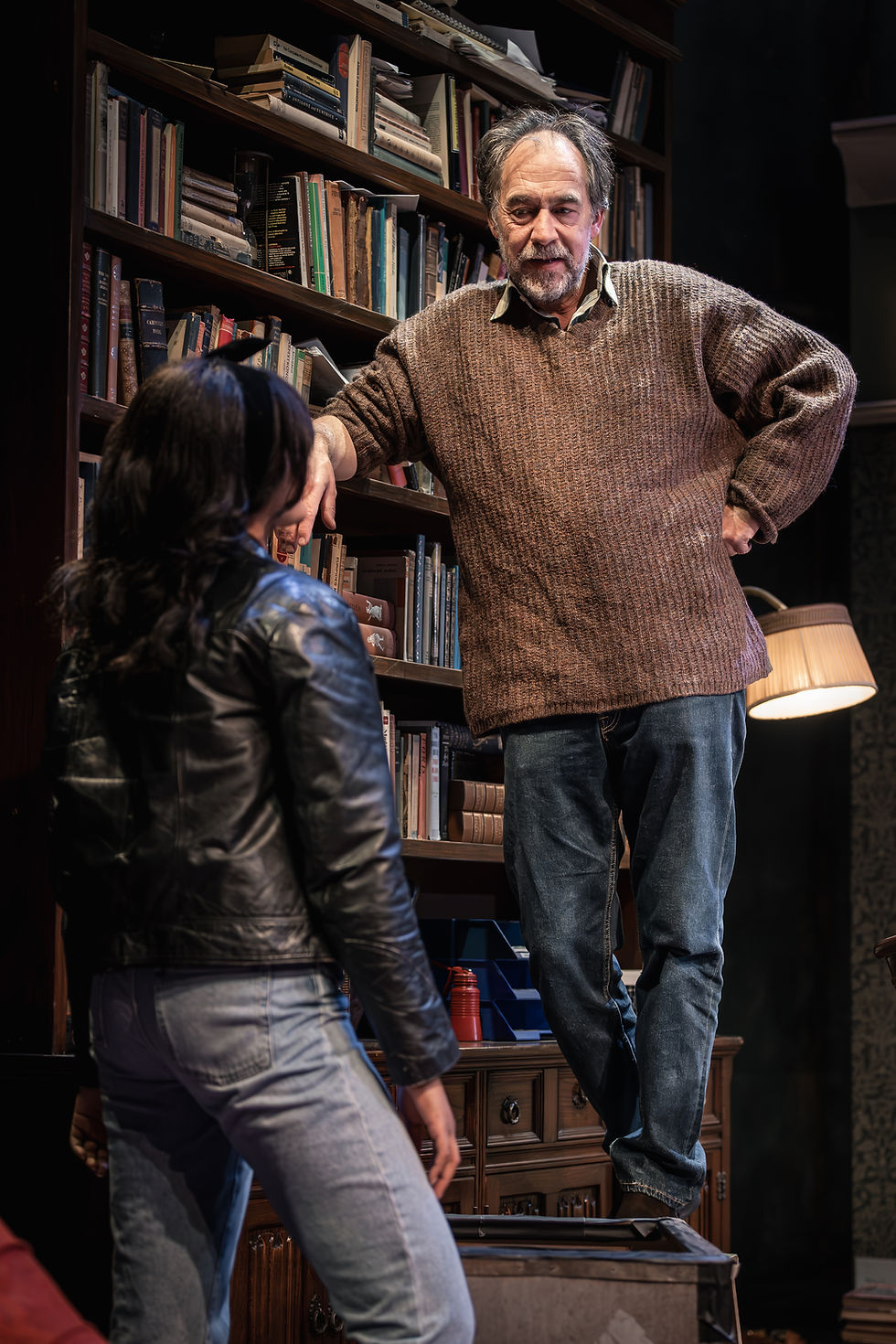
The show's biggest asset is Charlie Corcoran's set, with a gorgeous two storey apartment. Dylan's room is a darker blue that hides away in the shadows, compared with the otherwise modern, rich but minimalistic household. The bookshelf is full, there are plants peeking through the doors and windows, a stocked kitchen and plenty of lamps. The set unfolds to reveal Brad's smaller and warmer home in an astonishing reveal. The other lawyer's office too is unfolded from behind the bookshelf in another impressive turn with its formal setting. The house takes a turn in the second act, with crooked paintings, piles of rubbish and Amazon boxes, a dirty kitchen and broken door which is wonderfully detailed. Jack Wei's lighting design is used well to illuminate Dylan's room and to create a chilling image of Dylan right after the car crash, along with the rushing of car headlights. Emily Drohan's sound design is miniscule, only really appearing for the car crash,but with great effect.
Affluenza is a play that struggles to achieve what it sets out to do, and seems quite indecisive of what it wants to be. However, for fans of Schnapp, it's probably worth the trip (even if he's confusingly underused given the marketing).
Affluenza is playing at the Riverside Studios until 28th November - tickets and more information can be found here.
★★☆☆☆ (2*)
Gifted tickets in return for an honest review | Photography by Danny Kaan



Comments