

Educating Rita | Leicester Curve

Educating Rita at the Leicester Curve, which was written by Willy Russell in 1980, finds itself as engaging and relevant as ever with a timeless essence to the themes and characters. Directed by Cara Nolan, this new adaptation of the play sparkles with a confidence that thrusts audiences right into the play, performed expertly by two actors who seem to have lept right off the pages. The show, advertised as a comedy, brings out the delights of the clever humour and the delicacy of a subtle yet stinging tragedy, but is ultimately a thought provoking and entertaining evening at the theatre.
Educating Rita follows the University Professor and Poet Frank (Dominic Mafham) as he stumbles through his monotonous life, seeking joy only at the bottom of a bottle in his solitude. Having agreed to tutor a student from the Open University, solely to fund his nightly trips to the pub, Frank finds himself mentoring the bright eyed and outspoken Rita (Alexandra Mardell). An ambitious, witty and clever young woman who vows to do and be better than the life afforded to her, Rita is hungry for knowledge. Often limited by her working class community's lofty lifestyle and her husband's insistence on being a "proper" woman, Rita battles against her circumstances to belong to a different world. The play unfolds through a series of conversations as the two discuss literature and theatre, although often punctuated by Rita's tendency to overshare about her personal life and interrogate Frank about his. As the seasons change, so does Rita's perspective and ultimately she leaves a stranger.
Russell, whose work has been continually performed and studied in schools, is at the top of his game with a play compromised almost entirely of dialogue, that has the audience in its clutch throughout. The play was written during Margaret Thatcher's regime and draws upon references of the time, and yet still transcends this specific time frame, making the piece feel as fresh as ever. The script is well crafted with a tight paced play that really needs no additional theatricality. Russell's writing is "dead clever", brilliantly portraying the gaping divide between the mentality and vocabulary of the "educated, university folk" and the working class folk through Frank and Rita, deploying phrases like well packed humourous punches.

As Rita questions everything, she brings the use of certain vernacular into the spotlight, leaving audiences laughing out loud before a quiet realisation sinks upon the room. The discussion of the literary figures and works is fascinating, as well as the parallels that one can draw between them and the characters currently on stage. Interestingly, this too can be left up to audience interpretation, whether it's the slow sinking into his alcohol addition and self esteem issues of Frank, or the loss of the individuality and the formality that descends upon Rita's personality that becomes the inevitable tragedy. Both characters are simultaneously right and wrong throughout the play, treading through murky waters as they each strive to fulfill their potential.
Mafham does a brilliant job at portraying the weary Frank, whose esteemed profession distracts from his drinking problem. Whilst his mind is as sharp as ever, managing to not only counter Rita's inquisitive nature but raise his own questions, the subtle physicality in his stooped stance reveals his slow downfall. Mafham toes the line well between a firm professor who is fascinated or even amused by his new student, and a caring friend when Rita's personal life takes a tumble. His frustration at himself and at Rita's transformation is evident in the sharp comments and short temper, yet still managed to present Frank as a warm and safe presence.
Mardell is astonishing in the role of Rita. She comes rushing through the door, turning the room and the play on its head with a dynamic portrayal that demands every ounce of the audience's attention. The endless dialogue feels natural and funny in Mardell's voice, and she steals the show. Mardell ensures that Rita never once feels "too much" or "annoying", giving her a sweet agenda whilst wearing her heart on her sleeve. Mardell's accent and vocabulary has been practiced to perfection, really highlighting the differences that she hopes to bridge. Rita is a well written character but needs a performer to truly understand the role, and Mardell feels as though she were born for it. She ensures that every word of the spit fire dialogue is felt and appreciated by the audience, and her triumphant portrayal of the character allows for audiences to really feel the tragedy of her change towards its end.

Katy Morison's lighting is most noticeable as a bluish spot light shines through the windows, as Frank's mental state gets darker, but is often a rather warm state above the entire office. Jack Baxter's sound design is minimal, allowing for the dialogue to have full attention instead, only offering a miniscule and yet wonderfully effective heartbeat rhythm during more tense moments or smaller noises from the outside world. The actors are not wearing microphones, which could potentially be an issue for audience members towards the rear of the auditorium, especially as Curve's layout involves two shows to play in two auditoriums simultaneously (and Sylvia, a revolutionary musical about the Suffragettes can be quite, explosive at times).
Michael Taylor's set creates the warm alcove of Frank's office with well stocked bookshelves (full of books and hidden bottles) with a cosy sofa and wooden desk that help create an elegant style to the room. However, the warming sensation of the room can feel stuffy through the smaller details of the the messy stacks of paper, distressed cushions, the carelessly dropped furniture or even the clear aging of the furniture. The room well represents tat Frank's comfort zone may in fact be causing him harm, making the visual metaphor of his often stuck door all the more important. A singular window is used well, especially as Rita becomes more interested in the world outside.
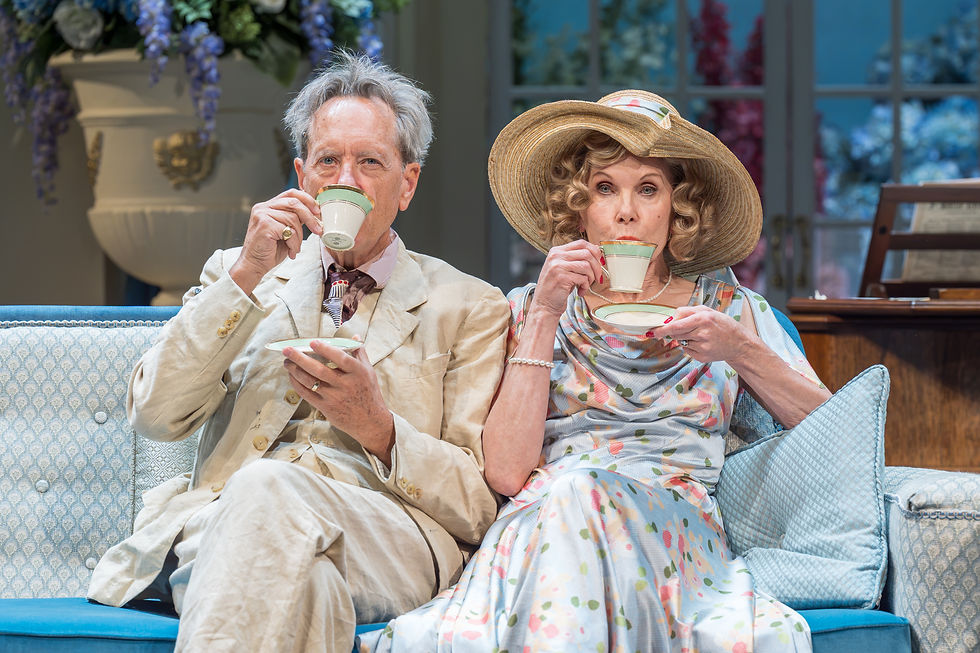
Taylor has also designed the costumes, which do wonders again in representing the characters. Rita, for the first act, adorns the same skirt with an array of different colourful jumpers, as she tries to resist buying new clothes. The bright colours contradict everything else in the room, but are a fun splash to the slightly mundane space. In the second act, however, her fashion sense has changed immensely, as she wears new outfits in every scene with a more confident and put together style.

Cynthia De La Rosa has also given Mardell a wig that feels more 'western' as she tries to emulate the other students at the university with straight and styled hair. It's a jarring shift from the first act, which aids in ensuring that audiences feels just as blind sided as Frank. Frank's own outfit remains either similar or the same throughout, in an old coat, shirt and trousers, clearly an outfit picked out decades ago and is continued out or routine.
Educating Rita is a play that will always be thought provoking, entertaining, tragic and inspiring, and Cara Nolan has cast a new and deeper insight into the script with two brilliant performers.
Educating Rita is currently playing at the Leicester Curve until 17th October - tickets and more information can be found here.
★★★★☆ (4*)
Gifted tickets in return for an honest review | Photography by Jonathan Pryke



Comments