

Three Men in a Boat | Rose Theatre

Three Men in a Boat has consistently been in print and popular with British readers since it was first published in 1889. Written by Jerome K. Jerome, the novel had apparently been envisioned as a serious travel guide as he and his two friends, George and Carl (Harris in the book and play), set on a boat trip from Kingston to Oxford. However, when a trio of friends take to the waters together, how can it be anything but a hoot between best buddies and the perfect foundation for a comedy.
Rose Theatre feels like the perfect venue to stage an adaptation of this novel, being in Kingston and allowing for the more location specific jokes to resonate deeply with its audiences. The novelty of the text is in its familiarity with smaller stops along the way; having thus inspired countless boat trips following the same pathway. Despite being written over a century ago, the characters and even the jokes still feel witty and relatable, delighting audiences in the absurdity of it all.
The stage adaptation has been written by Al Smith, who has kept the wit and fan favourite moments in the show whilst adding in more tongue-in-cheek moments that break the fourth wall and make playful jabs at the casting. Additionally, this adaptation has original songs by Grant Olding that help with scene transitions. The show is a play with songs as opposed to a musical, with the songs performed as an ending to scenes or as an extended joke of a previous gag, often in front of the closed curtains.
Directed by Christopher Haydon, the show knows what it wants to be and accomplishes that with its farcical tone, as physical comedy and dialogue ramp up the humour, providing audiences with the promised riotous comedy. Paired with superb performances from the three leads (and Monty the dog), the show reminds audiences of the talent that goes into carefully crafting a comedy, with nearly every scene carved to precision to have audiences besides themselves. The show leans heavily into the physical absurdities that occur, even including the audience in their shenanigans.

John Nicholson, as movement director and comedy consultant, has thought of everything. From the three men being lost in the maze (or labyrinth) that is the Waterloo train station as an opening sequence, which is an excellently choreographed piece, to a truly has to be seen to be believed Swan attack with feathers galore, to a trippy dance number whilst hallucinating, Nicholson is the perfect man for this job. The use of breaking the fourth wall is engenius, especially on press night by making playful digs at theatre critics. Riad Richie as the fight director includes more shambolic sequences that throw caution to the wind and have the performers going full force, whether they are fighting with one another or the swans. Both scenes are two prominent highlights of the show.
Simon Kenny's set is a gorgeous backdrop of a picturesque British lake view. A wooden sailboat piled with suitcases sits centre stage for most of the show as the cast pretend to row. The boat's movement, however, comes from either being placed on the theatre's revolve, or the use of other scenery on the revolve to great effect. Kenny also designed the colourful and flamboyant costumes worn by the three men. Jerome's in particular are particularly out-there and lavish, yet still quite dapper. Simisola Majekodunmi's choice to use ripples of white and blue is inspired, but is particularly impressive during the scene where the three men are hallucinating with the multi coloured spotlights flashing.
Olding's songs often continue Smith's wordplay, with its increasing perplexing rhymes that shouldn't work and yet somehow do. The songs often feel detached from the rest of the comedy, solely due to its more vaudeville nature; especially with choreography by Simon Hardwick that feels more playful than Nicholson's precision. Yet, these are very entertaining to watch. The three performers muster all their enthusiasm and it does evoke a childlike sense of joy and wonder to watch the song and dance occur, even if it doesn't really add to the show at all.
Jerome's original trip may not have included a dog, but the novel and all subsequent adaptations have included Monty (Montgomery). Designed and Made by Charlie Tymms, Monty is a particularly adorable dog, made up of old tartan from suits and well padded, looking particularly endearing. Chris Pirie directs the puppetry of Monty, which embodies a real dog with sincerity, making him a major asset to finding the play's emotional anchor.

Calum Donald-Bruce puppeteers Monty, doing such an admirable job that one could almost forget he was there at all... that is until he's caught without Monty leading to perhaps the show's funniest moment. Donald-Bruce allows Monty to feel fully realised as he wags his tail, licks himself and tilts his head in the background. Monty, being a well designed puppet, is able to be incredibly flexible, allowing for Donald-Bruce to really explore and play with the endless possibilities, including a scene where Monty is deeply philosophical and issues deep wisdom.
The three performers are each at the top of their game, with performances that are dynamic, intelligent, farcical and just thoroughly theatrical. Bronté Barbé, through the use of facial expressions, heavy layers and a suit, short and well styled hair, makes for a rather convincing man. Barbé has studied well, opting for a slower and heavier air about her and a deeper voice; it's great portrayal, although the audience are in on her secret casting, making her performance even more extraordinary as she performs on two varying layers. Barbé's Harris is a well intentioned, bumbling and bewildered man with a good heart, with Barbé's own stage presence adding to his good natured charm. Barbé's facial expressions are priceless, wordlessly having the audience in splits and she sings beautifully.
Johnny Weldon as Jerome does a brilliant job at portraying the self indulgent and occasionally pompous, self appointed captain of the trip. Taking over the trip and priding himself with having caught a massive 20-pound trout (that accompanies them in a display box), his tales about his Oxford years is spun to no end. Often impatient and short tempered, Weldon is a hilarious individual that is deeply entertaining. Weldon has an undeniable dynamic presence, especially with his flamboyant outfits and dramatic flair, bringing the house down more than once.
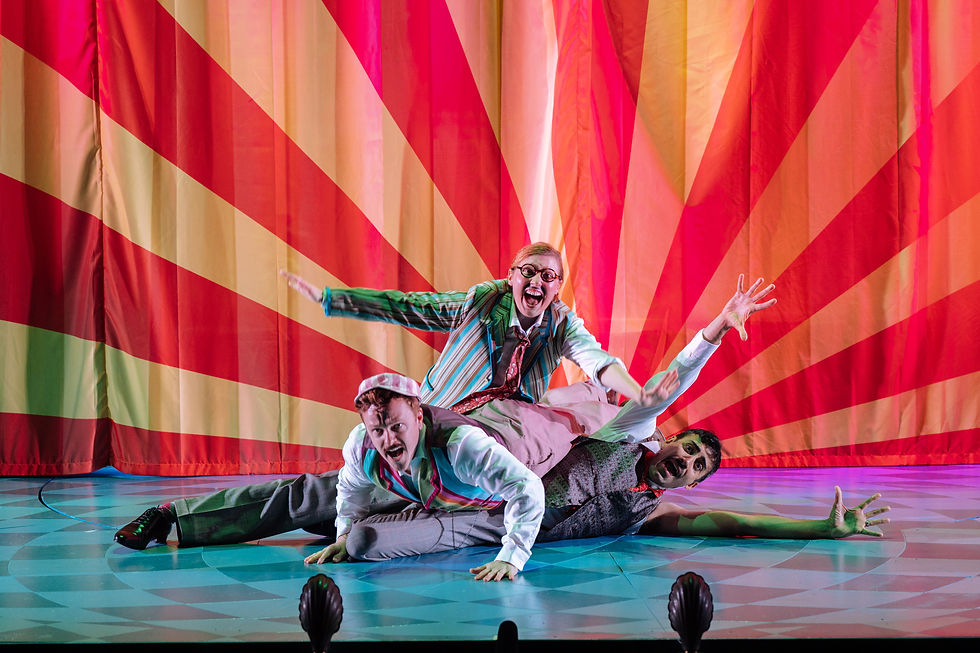
Richard David-Caine is astounding as George, the final member of the trio who is mourning the loss of his wife. David-Caine perfectly balances out the innocence of Barbé and the outgoing Weldon with a performance that hits every mark perfectly. David-Caine handles the humour with an expert hand, often encouraging and enjoying the gags himself with the smartest comebacks that leave the audience in splits. However, it's his turn towards the end of the show where he confesses the unspeakable truth as he hold back tears with a cracked voice and an emotional portrayal, that is a drastic departure from the rest of the play to great effect. David-Caine and Weldon are often at odds, creating a fun friction throughout the piece that culminates in a rather wholesome moment.
Three Men in a Boat has stood against the test of time for nearly 13 decades, and with a production as finely tuned as this, it's not hard to see why. A quintessential British comedy with strong performances, an excellent script and jokes galore, it's a guaranteed fun trip to the theatre.
Three Men in a Boat is playing at the Rose Theatre until 10th October - tickets and more information can be found here.
★★★★☆ (4*)
Gifted tickets in return for an honest review | Photography by Helen Murray


Comments