

The Sound of Absence | Omnibus Theatre

The Sound of Absence, which is written and performed by Yanina Hope and directed by Ivanka Polchenko, uses live music, movement, storytelling and spoken word to take audiences on a journey of grief, regret and love. Inspired by her own complicated relationship with her father, Hope's show aims to find solace, understanding and peace, both as a performer and a daughter.
The show chronicles Hope's fractured relationship with her father from a young age, as she switches between past memories and present consequences, following his death nearly three years ago. The plot doesn't follow a particular structure but audiences are able to piece the timeline together and can find when the relationship began to split before completely ripping apart. This also aids in understanding her current state of isolation and distrust, particularly in romantic relationships, that are a direct consequence.
Hope's play explores a number of interesting ideas and has a solid premise that feels relatable. As a writer, Hope's spoken word is beautifully poetic and draws on several moving metaphors and powerful lines. However, these often don't reach the impact that they deserve, as they don't necessarily lend themselves well to the halting performance that lingers on the words for a little too long, thus losing their momentum. The poems almost feel better suited to be silently read in an accompanying booklet of sorts, where audiences can really sit with the words in their own time. Hope also references Poet Dylan Thomas' Do Not Go Gentle Into That Good Night with a ferocity that often felt out of place, especially with how often it is used.
Hope's storytelling has moments of emotional impact through tender memories, yet feels disjointed and ultimately empty on the whole. Hope's attempt to weave an intricate web of memories with threads that crumble on their way to the present day, doesn't quite flow as smoothly as one could hope for. The foundation for the writing is a rich one, brimming with strong good ideas, but this quickly wears out its welcome with exaggerated repetition, making it hard to engage with the show as a whole.
Hope's turn as a performer unfortunately doesn't add much to the already shaky writing, with the constant emotional outbursts feeling forced and thereby losing credibility. With the show being inspired by her own experiences, the moments of subtle emotional breakthroughs or a painful realisation would have felt more authentic than the attempt to maintain a passionate and loud constant hysteria.
Director Polchenko, perhaps aware of this, attempts to counter this with prolonged moments of silence wherein Hope is crouched in a corner that doesn't necessarily add anything to the play. The performance leans too far into both extremes, instead of the healthy middle and unfortunately becomes the undoing of the show. Movement director Anna Korzik steps in with frantic movement that has Hope pacing the length of the stage, or shaking as her emotions overwhelm her. However, these movements sadly do not feel organic, and doesn't help audience feel sympathetic for Hope's plight either.

The show's saving grace comes in the form of Vladyslav Kuznetsov, who is the composer and on stage pianist. Kuznetsov's music lifts the show by a large margin, providing an emotional underscoring that the show desperately needs. The music is exquisite, with an impressive flair and confidence that lures audiences in. At moments, Kuznetsov's playing steals the show and provides a welcome parallel narrative.
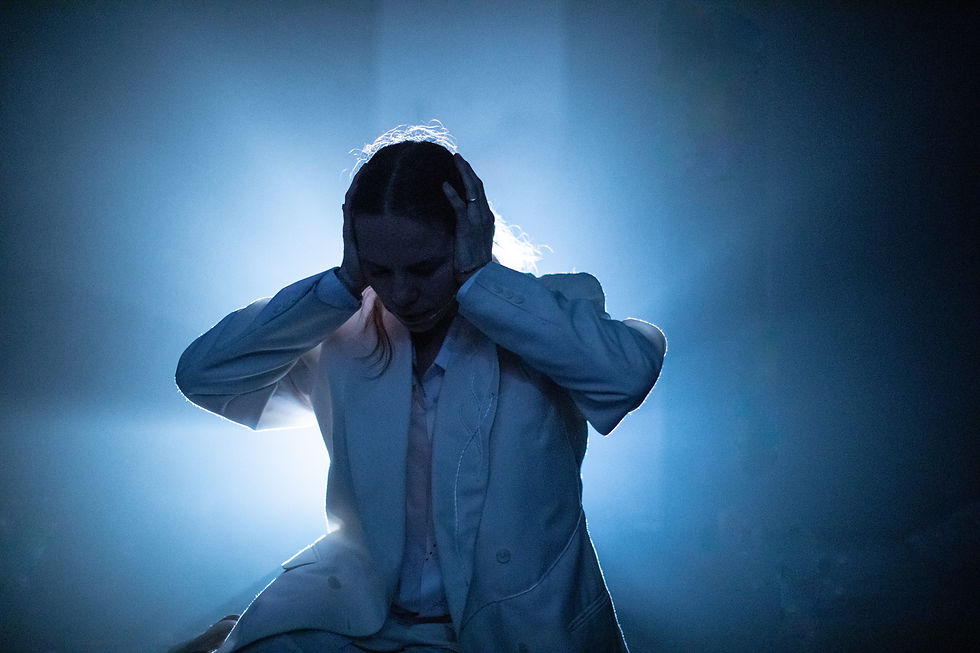
TheGeorgeNet has provided the lighting design for the show and it is gorgeous. The lights provide a stunning visual element to the show, with the flicking lights, red illumination, rippling projections and smoky spotlights that visualise the crippling grief and angry outbursts. The light aids with Hope's movement, allowing her to travel the length of the stage with an air of mystery, whilst also providing and ominous air to Kuznetsov throughout with a red light emerging from within the piano. There are moments of mesmerising lighting design and Kuznetsov's playing that work so well together, that it is almost hypnotising; and deserves a huge credit for elevating the show.
Shahaf Beer's costume design has Hope in a large and heavy cream-white suit that is slowly stipped away to reveal a white shirt with red threads embroidered on the left. A touching tribute to the heart troubles and surgery that Hope's father suffered, in a clever and sensitive manner. Beer's traverse staging allows for Hope to walk along the audience and really claim the stage. Kuznetsov and his piano is placed at the far end of this staging, feeling almost as though he were a part of a different show (with only one moment of interaction between them). The use of four props, denoting the four key memories that Hope shares, as a hanging mobile above the audience is a wonderful touch yet takes a while to arrive at this creative choice.

The Sound of Absence is a thoughtful show about how messy grief can be, but sadly echoes its sentiments with a final play that doesn't quite know its own identity... yet with a first class musical underscoring.
The Sound of Absence is currently playing at the Omnibus Theatre until 28th February 2026 - tickets and more information can be found here.
★★☆☆☆ (2*)
Gifted tickets in return for an honest review | Photography by Valya Korabelnikova


Comments