

Lucy Penrose (Grease: The Immersive Movie Musical)

Grease: The Immersive Movie Musical returns to Evolution London in Battersea Park after an incredibly successful run last year. Returning to the role of Rizzo is Lucy Penrose, and in this interview, she reflects on how her relationship with Rizzo and the musical has evolved as well as the freedom that immersive theatre offers both performers and audiences, whilst also balancing these aspects as a neurodiverse performer. Playing one of musical theatre's most iconic characters, Lucy also discusses balancing the vulnerability beneath Rizzo's tough exterior and what makes this production such a unique way to experience Grease.
1) You’re returning as Rizzo after last year’s sold-out run of Grease: The Immersive Movie Musical. What made you want to come back to the role?
There was genuinely no question for me. I adore playing Rizzo, she feels like a partner in crime now, and there’s something really special about getting to return to a character at different points in your own life. I’m older than I was when I first played her, and as I’ve changed, so has the way I understand her. Things I might once have seen as bravado, I now recognise as vulnerability, self preservation or courage. It feels a little like we’ve grown up together. And this particular version of Grease is such a joy because there’s so much freedom within it. The audience changes every night, so Rizzo gets to change with them. I know her incredibly well now, but she still surprises me. Plus, I get to wear the Pink Ladies jacket again, which is always a strong argument.
2) Did you learn anything about yourself as a performer or Rizzo as a character that you’re taking with you into this current run?
Definitely. I think last year taught me to trust myself much more as a performer. Immersive theatre doesn’t allow you to hide behind a fourth wall. You have to listen properly, respond honestly and trust that you know the character well enough to let them exist outside the scripted scenes. With Rizzo, I’ve realised that I don’t need to push the toughness. It’s already there. Actually, the more comfortable I’ve become with her, the more I’ve been able to let the quieter, softer and sometimes sillier parts of her come through. I used to love being able to be bold and brassy because as a person I wasn't that, but now I am so much more enjoying her moments of kindness and warmth.
3) What was it about Rizzo or Grease that made you want to be involved? Are there any ways in which you relate to her character?
I’ve always thought Rizzo is incredibly misunderstood. People remember the sarcasm, confidence and bravado, but when you look at her in the context of 1950s America, I think she’s actually quite radical.
One of the things I love about acting is that you have to be a historian. Rizzo is an Italian American woman growing up in a world with very rigid expectations of what a young woman should be, and she rejects almost all of them. Even visually, with the short hair, the iconic black outfit and lack of a poodle skirt, there’s something almost rockabilly and anti establishment about her. She owns her sexuality, her intelligence and her choices. I think she’s a feminist before she would necessarily have had the language to call herself one.
That’s also why I don’t think she hates Sandy, as I am often accused of. I think she sees someone still trying to fit into this perfect version of 1950s Americana and challenges her to work out who she actually wants to be. I definitely relate to Rizzo’s humour and her refusal to make herself smaller or more palatable for other people, I would actually say she taught me that and I have taken that lesson into my real life. She’s messy, contradictory and sometimes chooses the tougher side of tough love, but that’s exactly what makes her so human and so exciting to play.

4) Rizzo is fiercely independent but also vulnerable. Which side of her do you most enjoy exploring during the performance?
The space between the two, partly because I have the time to. I don’t really see Rizzo’s independence and vulnerability as separate sides of her. I think they feed each other. A lot of her toughness exists because she feels things incredibly deeply, so the most interesting moments for me are when the armour slips slightly and you watch her immediately try to put it back on.
That’s one of the great joys of immersive theatre because we get to fill in the blanks between the moments you know from the film, which is what I mean by having the time to explore the space between the two. These characters don’t simply disappear when they’re off screen. They carry on living, and that gives us the opportunity to create much fuller emotional arcs for them. There’s a wonderful moment, for example, where if you happen to venture to the fairground at the right time, you might find Rizzo and Kenickie, played by the incredible Arcangelo Ciulla, just having lots of fun together. You get to see a warmth and softness between them that the film doesn’t necessarily have the time to explore. It gives you another piece of the puzzle as to why these two people are drawn to each other and what exists underneath all that bravado.
Those are probably my favourite moments to play because sometimes the audience catches something Rizzo absolutely did not intend them to see. I find that much more interesting than simply deciding, “Rizzo is vulnerable now.” With her, the vulnerability is always there. On screen, she’s very good at making sure you don’t see it, but in our show, it carries on off screen and you get to see the before, after and if you have questions you can ask.
5) Do you have a particular moment or song in the show that stands out for you?
It has to be There Are Worse Things I Could Do. You spend so much of the show with Rizzo moving quickly, talking quickly, joking, deflecting and controlling what everybody else gets to see. Then suddenly everything becomes still. It’s one of those songs where you don’t need to do very much to it because the writing does the work. You just have to tell the truth. Getting to have that moment every night is a real gift.
6) Grease is a cult favourite. Does this present any challenges or pressures as a performer?
Of course. People know this film inside out. They know the lines, the songs, the looks, the gestures. There are people in the audience who have loved Rizzo longer than I’ve been alive! But I actually find that quite freeing. I’m never going to out Stockard Channing, nor would I want to try. My job is to honour what people love about the character while finding the human being underneath it. If you chase an impersonation, I think you lose what makes live performance exciting.
7) Nearly 50 years after the film’s release, Grease continues to attract new generations of fans. Why do you think the story still lives in the hearts of so many people?
Obviously the music helps enormously. It’s ridiculous how many absolute bangers are packed into one film. But underneath all the leather jackets, cars and 1950s nostalgia, it’s about being young and desperately trying to work out who you are. Everyone at Rydell is performing some version of themselves. They’re trying to fit in, which is a very human experience. The specifics change from generation to generation, but sadly that feeling of wanting to belong doesn’t.

8) How do you strike the balance between honouring such an iconic film while making the characters feel fresh and authentic?
For me, you honour the film by taking the characters seriously rather than trying to recreate every choice that was made in 1978. There are obviously iconic moments that audiences want and deserve to recognise, but between those moments we have this enormous opportunity to ask who these people actually are. In an immersive production especially, the characters have to exist when they’re not saying famous lines. Rizzo needs opinions about people, relationships, school, what happened yesterday and what she thinks might happen tomorrow and it is those opinions which are what keep it feeling fresh. Once you build that whole person, the iconic moments hopefully feel like they belong to them rather than something we’re reproducing.
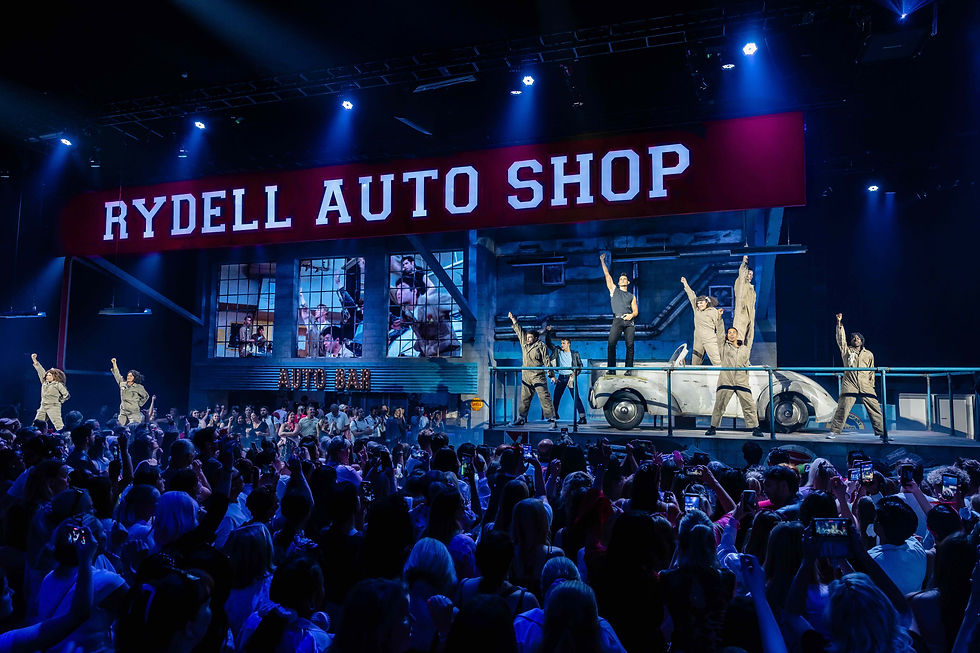
9) With audiences moving through locations such as Frosty Palace, the Autoshop and the Carnival, the environment becomes almost another character. How does performing in these spaces influence your performance?
Massively. You’re not asking an audience to imagine Rydell High, they’re standing in it with you. Each space gives you something different to play with and changes the way the characters behave. There are places where Rizzo feels completely at home and others where her energy shifts. You also become incredibly aware of how audiences move through the world, where their attention goes and how you can draw them into something without making them feel like they’re simply being shepherded towards “the next scene.” The environment does a huge amount of storytelling before we’ve even opened our mouths.
I also love that, as an actor, if I’m feeling adventurous and have a little spare time outside my track, I can just go and play in the world. One day, Sandy, played by my darling friend Stephanie Costi, and I happened to have a spare moment, so I convinced her to help me break into the principal’s office to find out my end of year grades. A few adventurous audience members who had wandered off to explore Rydell stumbled across us and suddenly had this completely unique little scene that may never happen again.
That’s the joy of how detailed the world is. You can open a random folder and find historically accurate paperwork that gives you something new to play with. And, for anyone wondering, Rizzo passed with flying colours. So did Sandy. I’m sure Principal McGee will be thrilled to know we broke into her office to find out.
10) Does that unpredictability keep each performance feeling fresh for you?
Completely. It’s one of my favourite things about the show. You can know your track backwards, but you can never predict the audience. Someone can say something you could never have anticipated and suddenly you’re having a conversation that has never happened before and will never happen again. What’s particularly exciting is that the audience can actually influence my storyline. I’ve had audience members give me things, tell me information or involve themselves in Rizzo’s world in ways that have genuinely changed what happens next. I can take something they’ve given me into another interaction, and suddenly a little storyline develops that simply didn’t exist at the beginning of the night. Sometimes it even follows me through several different locations. Like the day we found out who stole the Castor Oil.
That’s the magic of immersive theatre for me. The major story beats remain the same, but everything between them is alive and constantly changing. It keeps you incredibly present as an actor because you simply can’t go onto autopilot. The audience won’t let you, and occasionally they end up writing a little bit of Rizzo’s story themselves, I will never forget when I ended up drinking a shot of mustard because of losing a card game.
11) How do you prepare for that level of interaction each night?
For me, preparation is less about having a catalogue of clever Rizzo answers ready and more about knowing her well enough that I don’t need one, plus a lot of mouth dexterity exercises to keep up with the pace! You need to know what she wants, who she loves, who irritates her, what she’s insecure about, what’s just happened to her and what she thinks about the world around her. Then, when somebody asks you something completely unexpected, you’re not thinking, “What would Rizzo say?” You just answer.
I don’t think I’ve spoken about this in an interview before, but I also think it’s important for representation to say that I’m neurodivergent. An immersive show of this scale can, as you can imagine, be quite an overstimulating environment, so part of my preparation is about grounding myself so that I can have the freedom to play once I’m in the world. I’ve built little sensory anchors into that process too. Rizzo has a particular perfume, so the moment I smell it, something in my brain goes, “Right, we’re here.” I’m incredibly lucky to have such a strong connection with my castmates as well, particularly my scene partners. We check in, look after each other and are constantly aware of what the other person might need. So preparation for me is partly knowing Rizzo inside out, but it’s also knowing myself well enough to create the conditions where I can be completely present as her.
12) This production combines live performance with large-scale video, choreography and multiple performance spaces. What has impressed you most about the creative team’s vision?
The sheer scale of it is extraordinary, but what impresses me most is how all of those enormous elements still leave room for tiny human moments. You can have hundreds of people watching an iconic sequence unfold on a huge scale, and then minutes later you might be having a completely personal interaction with one audience member that nobody else witnesses. The creative team have managed to make something cinematic without losing the intimacy of live theatre, which is a very difficult trick to pull off. I must add that their talent is beyond belief and the world they have created is a marvel, it's an honour to work with this team.
13) What can visitors expect from Grease: The Immersive Movie Musical that they simply wouldn’t get from watching the film or going to see a conventional stage musical?
You get to go to Rydell.
You’re not sitting at a distance watching somebody else experience Grease. You can walk through the world, meet the characters, follow different stories, dance, sing and discover things that other audience members might never see. You can engage as much or as little as you want, but if you’re curious and willing to play, there’s an enormous amount hidden inside the world. You could genuinely come more than once and have a completely different night. And then, alongside all of that intimacy, you still get those huge cinematic moments exploding into life around you. It’s theatre, film, gig and night out all slightly smashed together.
14) Why should audiences come along?
Because you’ve watched Grease enough times. It’s time to actually go there. Come and join the Pink Ladies, hang out with the T-Birds, dance at Rydell, and let yourself become part of the story for a few hours. And most importantly, don’t worry about doing it “right.” Follow whatever catches your attention, talk to people, be curious and play. The more you give this world, the more it gives you back.
Grease: The Immersive Movie Musical plays for a limited run at Evolution London in Battersea Park until 13th September - tickets and more information can be found here.
Photography by Matt Crockett and Luke Dyson


Comments