

Hannah Power and Conor Murray (Don't Tell Dad About Diana)

After a successful run at the Edinburgh Fringe, Hannah Power and Conor Murray return with Don’t Tell Dad About Diana, a fast-paced coming-of-age story set in Dublin in 1997, where two working-class teenagers secretly prepare a Princess Diana drag act for Alternative Miss Ireland while navigating friendship, identity and the expectations of their deeply nationalist families.
We took the opportunity to speak with Hannah and Conor to tell us more.
Q) Hello - before we begin, please could you introduce yourself and tell us a little bit about what first inspired you to create Don’t Tell Dad About Diana?
We’re Hannah Power and Conor Murray, writers and performers of Don’t Tell Dad About Diana. The initial idea for the show came from watching the 1997 episode of Reeling in the Years and seeing peace talks in the North unfold alongside the media frenzy surrounding Diana. They were two things we had never really placed side-by-side before and we became fascinated by this overlap. We were interested in the push and pull of British pop culture in Ireland, particularly the way deeply nationalist communities could still feel connected to things like the English Premier League. That was the initial spark for writing the show!
Q) Without giving too much away, can you tell us a little bit about what the show is about?
The show follows two Dublin teenagers in 1997 preparing to compete in Alternative Miss Ireland 1997 with their Princess Diana drag act, all under the noses of their deeply nationalist families. As they race through the city towards competition night, Diana’s death begins to unravel not only their secret performance plans, but also their friendship and their dreams of leaving Ireland behind. It’s a fast-paced coming-of-age story about friendship, fandom, identity and trying to imagine a future for yourself beyond the life you’ve been handed.

Q) Why did you choose Princess Diana as such a central figure in the story? And why do you think she still continues to resonate so strongly, particularly within queer communities?
I think Diana represents somebody trying to carve out an identity for herself within a system that was incredibly rigid and traditional. There’s something deeply relatable in that, especially for queer people or anyone who has ever felt out of step with the world around them.
She also understood image and performance in a really fascinating way. She knew how to communicate without necessarily speaking directly and there’s something very theatrical about that. The show is more interested in the obsession and affection people projected onto Princess Diana than in retelling her life story.
Q) Can you tell us why it was important to tell this story through a specifically working-class Irish and Queer lens, particularly set in 1997?
1997 felt like a really interesting tipping point in Ireland. The country was changing socially and politically, but a lot of people still felt trapped by tradition, religion, nationalism and ideas around masculinity. It also just felt like a particularly camp moment in Ireland to us. It was the year of the first gay kiss on Fair City, Ireland hosted the Eurovision Song Contest 1997, and Spice Girls mania was absolutely everywhere. There’s so much humour, imagination and theatricality within both of those communities in Dublin that we wanted to celebrate.
Q) How does your show reflect on a generation experiencing change in Ireland?
There’s a feeling throughout the show of young people trying to outrun the limitations of the world around them while also carrying the weight of inherited politics and family expectations. A lot of that uncertainty feels very recognisable even now.
Q) Are there any parallels between Diana’s public life and the experiences of the characters?
The characters project a lot onto Diana. They see somebody glamorous and rebellious, but also somebody trapped within systems she didn’t fully belong in. That tension mirrors a lot of what the characters are experiencing themselves. The difference is that these two have each other. They are the neighbourhood weirdos, a strange little duo stumbling hand-in-hand through the awkwardness of their teenage years together. Whereas Diana navigated a lot of her harder times alone.
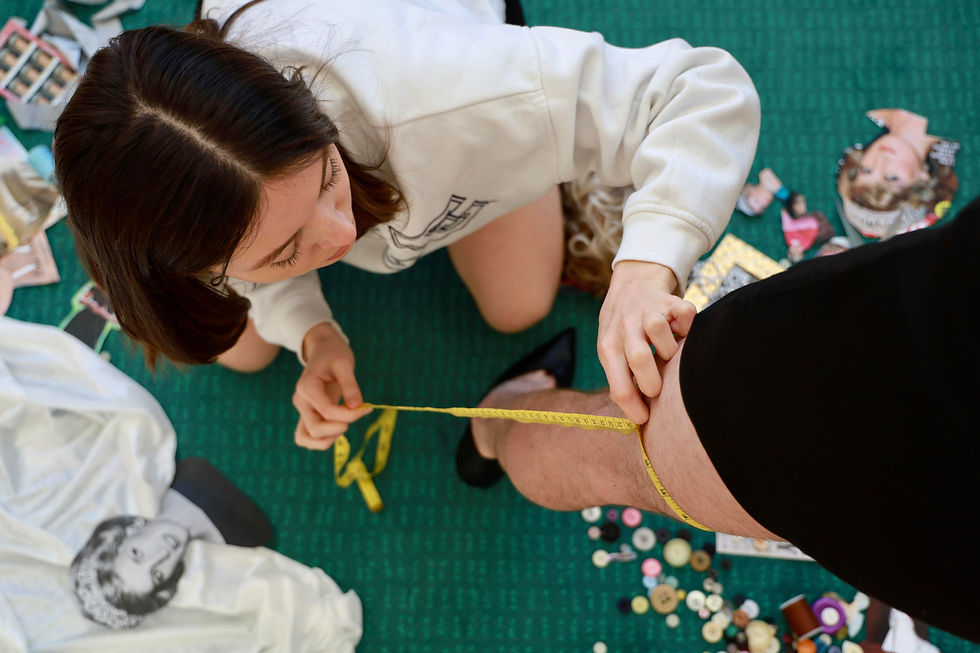
Q) The show is rooted in your own friendship and your lived experiences; can you tell us more about what aspects found their way into the script and how your friendship has helped to shape the development of the piece?
The show isn’t autobiographical, but the emotional core of the friendship definitely comes from our own experiences and from the intensity of teenage friendships generally. A lot of the humour and rhythm of the script comes from our own friendship too. We spend so much time together that the dialogue developed quite naturally through conversation and improvisation.
Q) How does it feel to return with the show after its success at Edinburgh Fringe? Has the show evolved at all since then?
It’s really exciting to come back to the show after Edinburgh. The response there was incredibly special and it gave us a lot of confidence in the piece and in the audience’s connection to these characters, from winning the Fishamble New Writing and Bewley's Little Gem Award, to being named as Theatre Weekly's Best LGBTQ+ show of Ed Fringe. The show has definitely evolved since then. When you spend more time with a piece you naturally start sharpening things and discovering new emotional beats or moments of comedy.
We know the world and the characters much more deeply now, so the show feels tighter, richer and more confident than ever.
Q) How do you think the themes will resonate with audiences? Why do you think audiences should come along?
Even though the play is rooted in a very specific time and place, the themes feel incredibly universal. At its heart, it’s a story about formative friendships on the cusp of great change and the people who shape us during those awkward years of becoming ourselves.
We hope audiences recognise something of themselves in these characters, whether that’s the awkwardness of being a teenager, the intensity of your first real friendship or the feeling of wanting your life to become bigger than the world around you.
Don’t Tell Dad About Diana plays at Underbelly Boulevard Soho on Tuesday 26 May and Thursday 28 May 2026 at 7pm. For tickets and more information, visit Underbelly Boulevard Soho.
Photography by Erica Verling and Romany Gilmour


Comments