

Grace Pervades | Theatre Royal Haymarket

“We see things differently, my sister and I, but there is one thing we agreed on,” says Edward Gordon Craig (Jordan Metcalfe), in the opening scene of David Hare’s Grace Pervades. “That our mother was great, surpassingly great.”
His sister Edy Craig (Ruby Ashbourne Serkis), finishes the line. “And in all the years we lived, no other actress ever came near.”
Grace Pervades, Hare’s 32nd play, takes as its subject the pair’s mother, Ellen Terry (Miranda Raison) and her professional and personal relationship with actor-manager Henry Irving (Ralph Fiennes), as well as the lasting impact on the two children raised largely in the Lyceum Theatre. The title of the play comes from a less than complimentary review of Ellen Terry, by contemporary Charles Read, who stated that “grace pervades the hussy”, alluding to Terry’s fall from grace in having two illegitimate children with a married man.
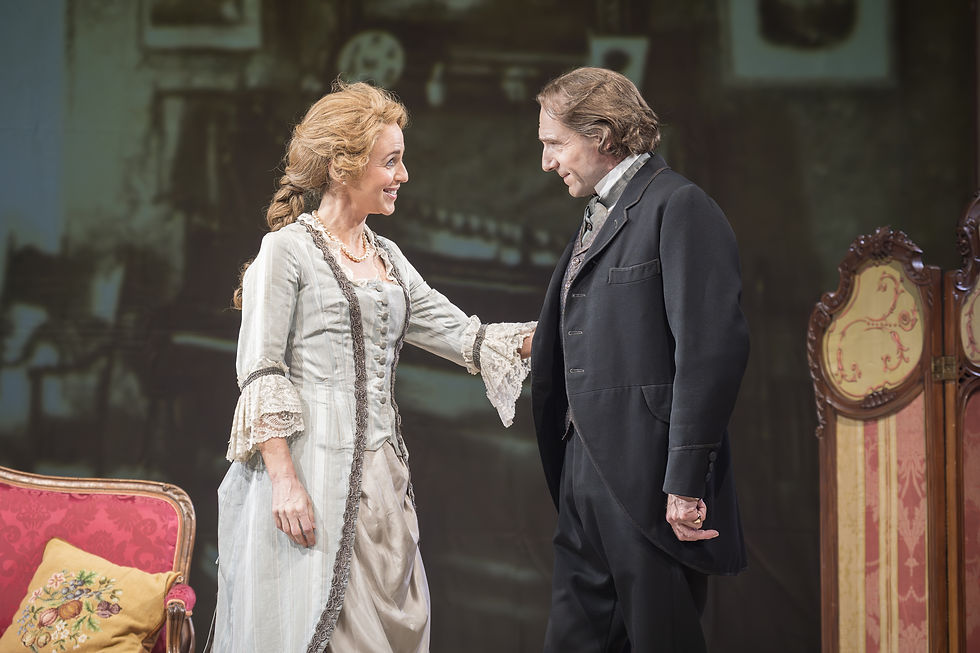
We meet Ellen Terry in 1878, when Henry Irving has come to call on her and her sister Kate (Kathryn Wilder). Ellen has long been overshadowed by her sister, “the talented one”, but it is Ellen who Irving wants to employ, having recently taken over management of the Lyceum Theatre.
There follows a tour through rehearsal rooms and stages, as the lives of Irving, Terry, and the Craig siblings intersect with several notable names of the late nineteenth and early twentieth century. We have Isadora Duncan (Saskia Strallen), conducting an affair with Teddy (as Edward is nicknamed) but lamenting that she knows he will eventually toss her aside. Vita Sackville-West never appears onstage, but gets special mention for being careless with the heart of one of Edy’s lovers, Chris (Maggie Service). And Stanislavski (Guy Paul), has the unenviable task of trying to stage a play with Teddy in Moscow.
Throughout, Hare is quick to poke fun at his characters, the theatre itself, and even his own material, as in one scene where Irving expresses his distaste for modern plays.

”People arguing, that isn’t theatre,” he says, as he and Terry continue their argument.
These pithy observations landed well with an industry-focused audience on media night, provoking frequent murmurs or recognition and outbursts of laughter, and the play’s sell-out run at the Theatre Royal Bath last summer proves its crowd appeal, though it is perhaps more pitched at a theatrical connoisseur than a casual theatregoer.
Still, the tour de force performances from Fiennes and Raison alone are worth the entrance price, and the play provides a fascinating insight into the lives of these acting greats.
Unlike Irving’s preference for pomp and grandeur onstage, Grace Pervades is staged in a minimalist but effective manner, with most scenes requiring at most a few pieces of furniture from set designer Bob Crowley to create a dressing room, a rehearsal space, or a provincial hotel. Backdrops are created on screen, as is increasingly common, and though in some cases it would have been just as effective without, Akhila Krishnan’s beautiful video design worked well particularly where it sought to recreate the more traditional hand-painted backdrops of the period.

Elizabeth Purnell’s sound design and Peter Mumford’s lighting were also used with a light and effective touch, particularly to enhance the scene transitions.
It is only really in the costuming that Irving’s taste for on-stage luxury comes through, with costume designer Fotini Dimou creating lavish outfits for the frequent snatches of Shakespeare which are scattered through the piece.
Audiences today may not be able to experience Ellen Terry and Henry Irving as they were, but through Hare’s magnificent play we can see a window into their world.
Grace Pervades runs at the Theatre Royal Haymarket until 11th July. For more information and tickets, follow the link here.
★★★★☆ (4*)
Gifted tickets in return for an honest review | Photography by Marc Brenner


Comments